Persian Carpet Repair and Restoration: Fringe, Edges and Rafou
Every carpet that is used will eventually need some attention. A fringe wears, a side edge loosens, a corner is chewed by a pet, or an old repair begins to show. Handled well and early, most of these are routine. Handled badly, with glue, scissors or a tug on a loose thread, a small problem becomes an expensive one.
This guide explains what carpet repair covers, what to look for, and what you should expect from a professional repair.
What rafou means
Rafou is the Persian term for repair or restoration work on a carpet. It can involve any part of the structure: the pile, the foundation, the fringe or the edges. The extent of the work and whether it is suitable depend entirely on the individual carpet.
Repair is not the same as cleaning. A carpet may need one, the other, or both, and they are assessed separately. For cleaning and everyday care, see our carpet care guide.
Signs your carpet needs attention
- Loose knots or areas where the pile is thinning to the foundation.
- Worn or loose side edges, where the binding along the long sides is fraying.
- Broken or shortened fringe, especially if the knots next to it are starting to loosen.
- Tears or holes, including damage from pets, furniture or moths.
- Previous repairs that are lifting, discoloured or no longer secure.
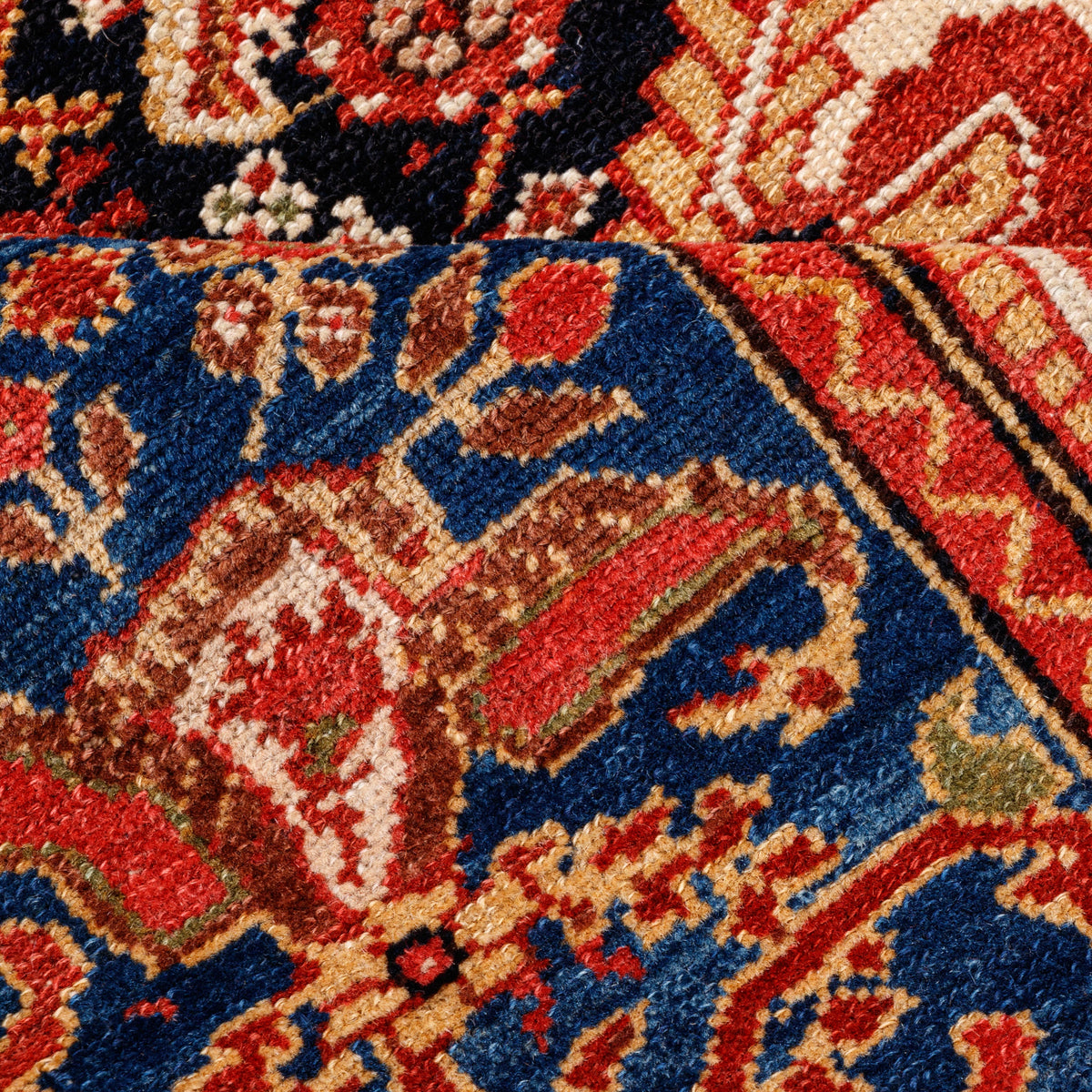
All of these need experienced inspection rather than a quick verdict. The fringe and side edges are structural parts of the carpet, not decoration: the fringe is usually the end of the warp itself, as our guide to the parts of a Persian carpet explains.
What not to do at home
- Do not pull a loose thread. It may be part of the structure and can unravel more.
- Do not trim the fringe to make it look tidier. The fringe is the warp, and cutting it weakens the ends.
- Do not use adhesive or tape as a home repair.
- Do not use household carpet shampoo or stain remover on a damaged area.
Leather on the back of the edges
You may notice leather fitted along the back of the side edges on some carpets. In our practice, this reinforcement is normally fitted to kork-and-silk carpets from centres such as Tabriz, Isfahan and Nain, to help prevent the sides from curling. We generally find that our full-silk carpets do not need it, although that is not a guarantee that no full-silk carpet will ever curl.
Two points are worth knowing. First, leather on the edge is not proof of a previous defect or restoration; it is often added as a preventive measure. Second, it can be fitted to your own carpet if it needs it, as long as the treatment suits the piece.
How a professional repair should work
Whoever repairs your carpet, a good repair follows the same sequence:
- Documentation. The carpet's condition is recorded when it is received, with photographs.
- Assessment. A specialist assesses the work needed, from photographs or in person.
- Quotation. You receive a price and an expected duration before anything starts.
- Approval. Work begins only after you approve it.
- No surprises. If further work turns out to be necessary once the repair is under way, you are told the extra cost and any change in timing, and that work is carried out only after you agree.
- Final check. The result is checked before the carpet is returned to you.
This is how we handle repairs. For stains, the workshop assesses whether complete removal is possible and whether a mark is likely to remain, and we explain that assessment and its separate cost before treatment. We do not promise a fixed percentage of improvement, because no honest restorer can before seeing the stain.
Does a repair reduce a carpet's value?
Condition affects value, and repairs are part of condition. But the presence of a repair is not automatically a negative. A skilful, well-matched restoration on a rare old carpet is very different from recent, visible damage on an ordinary one, and a timely repair usually protects value by stopping damage from spreading. Our article on what determines carpet price covers condition alongside the other factors.
Frequently asked questions
What is rafou?
Rafou is the Persian term for carpet repair or restoration. It can involve the pile, the foundation, the fringe or the edges.
Can a worn fringe be repaired?
Often, yes. The fringe is usually part of the warp, so it should be assessed by a specialist rather than trimmed or glued at home. Fringe can be repaired or, in some cases, replaced.
Why is there leather on the back of my carpet's edges?
Leather is often fitted to the side edges of kork-and-silk carpets from centres such as Tabriz, Isfahan and Nain to help prevent curling. It is usually preventive and is not, by itself, a sign of past damage.
Is carpet repair the same as cleaning?
No. Repair restores the structure; cleaning removes soiling. They are assessed and priced separately, and a carpet may need one or both.
Can you guarantee a stain will come out?
No honest restorer can guarantee that before assessment. We assess the stain, explain the likely result and the cost, and treat it only after you approve.
Send us a photo
If your carpet has a worn edge, a damaged fringe or an old repair you are unsure about, send us a photograph. We will tell you what we see and whether it needs attention.
- WhatsApp: +971 56 322 0485
- Showroom: +971 4 250 2123 — Al Barsha 2, Dubai
- Email: info@azimzadeh.ae
More about our service: rug cleaning and restorations.
Azimzadeh — Persian carpets since 1969. Dubai showroom: Azimzadeh Carpet Trading LLC, Al Barsha 2. The extent and suitability of any repair depend on the individual carpet.
Related reading: carpet care and spills · carpet certificates