What a Carpet Certificate of Authenticity Should Tell You
A certificate of authenticity is only as useful as the information on it. A certificate that says "Persian, wool and silk, hand-knotted" confirms very little. A good one describes the individual carpet precisely enough that anyone reading it later, including you, an insurer or a future buyer, can match the document to the piece.
This article explains what a carpet certificate should contain, how to read each field, and how the certificate we issue with every handmade carpet works. To check whether a certificate can be trusted, see our guide to verifying a certificate of authenticity.
Every handmade carpet we sell comes with a certificate
Every handmade carpet sold by Azimzadeh receives a Certificate of Authenticity, with no issuance fee. It is prepared once your purchase and invoice are finalised, and sent to the address you give us.
The certificate includes a photograph of the carpet, the purchaser and branch details, the carpet's recorded specifications and its product identifier, together with the official signature, stamp and embossed seal. The certificate states that it is not valid without the embossed seal.
How to read each field
| Field | What to check |
|---|---|
| Design origin and place of weaving | These are two different things. A design can be associated with one city and woven in another, so each should be stated separately. |
| Dimensions and area | Measured dimensions and a correctly calculated area, not a trade size name. |
| Pile and warp | Identified separately. A silk warp does not make a silk pile, and "wool and silk" alone does not tell you which part is which. |
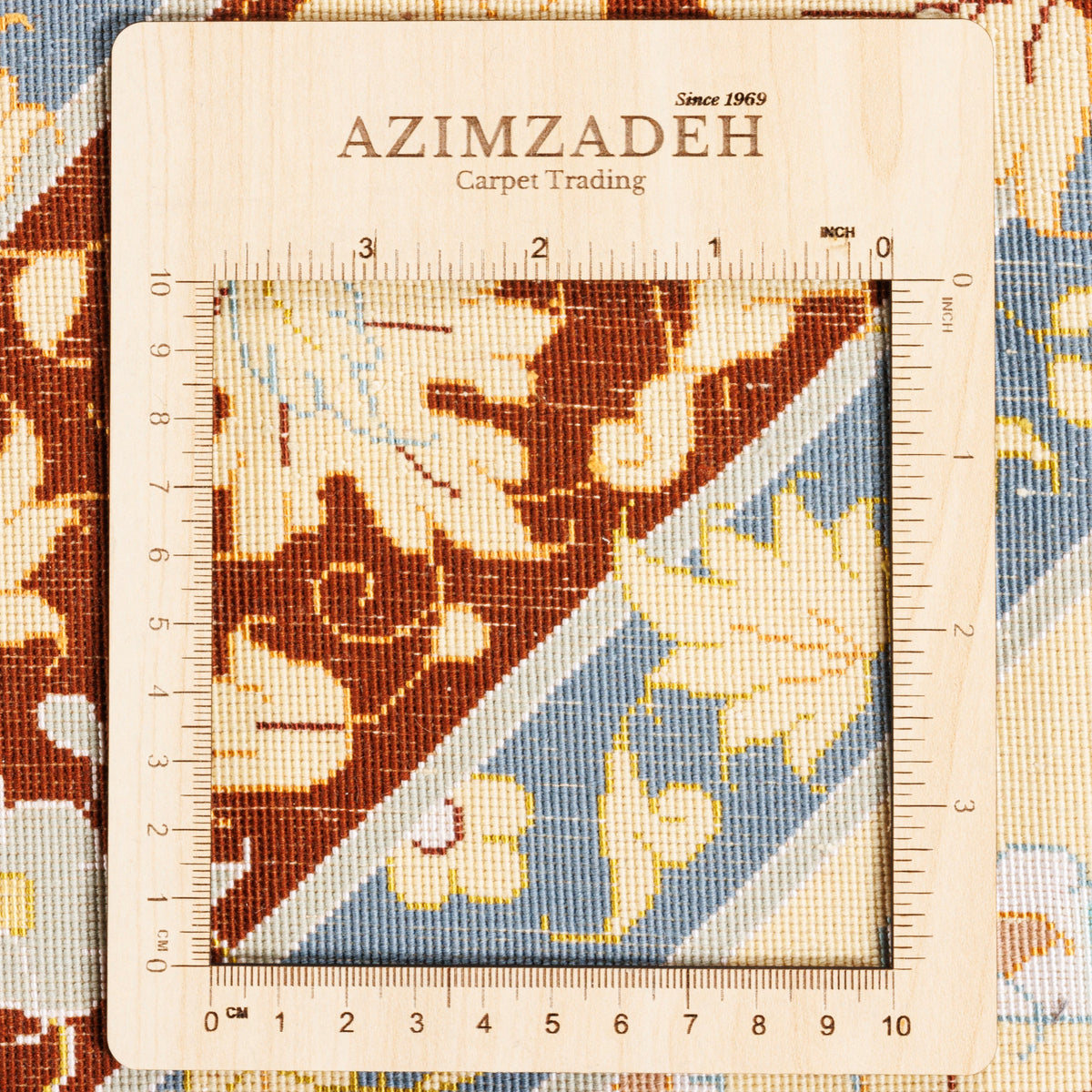
| Approximate knot density | Recorded in knots per dm², an area measure. It is not the same number as raj, which is a linear count. |
| Weight and additional information | Confirmed details only. Weight should be measured, not estimated from area. |
The density field is worth a second look on any certificate, ours or anyone else's. If you have been quoted a figure such as "60 raj" and the certificate shows 60 in a knots per dm² field, something has gone wrong: the two units describe different things. Our guide to raj explains why.
For the pile and warp fields, our guide to reading carpet materials covers what terms such as "silk highlights" and "full silk" establish.
The product identifier and the NFC cover
Each carpet is registered through GS1, the global product identification system, and the assigned identifier (a GTIN) is printed on the certificate. A guidance card inside explains how to look it up.
The certificate cover also contains an NFC chip. Tap it with a compatible phone and it opens the carpet's product information page.
It is important to be precise about what this does. GS1 provides product identification and lookup of the registered data. It is not an independent GS1 appraisal of the carpet's materials, age or value. The authenticity certificate itself is issued by Azimzadeh, and it is our statement about the carpet we sold you.
What a certificate is not
- It is not a valuation. A certificate records what the carpet is. A formal valuation is a separate exercise.
- It is not a care guide. The enclosed card explains the GS1 lookup and the NFC cover; for care advice, see our carpet care guide.
- A blank template or a photo of a signature is not a certificate. Nor is a product lookup on its own. The complete issued document, with its embossed seal, is what counts.
Keep it with the carpet's records
Store the certificate with your invoice. If you ever sell, insure, clean or repair the carpet, the certificate and the product identifier make it easy to confirm that the document belongs to that piece.
Frequently asked questions
Do your handmade carpets come with a certificate of authenticity?
Yes. Every handmade carpet sold by Azimzadeh receives a Certificate of Authenticity with no issuance fee.
What does the NFC chip in the certificate do?
Tapping the certificate cover with a compatible phone opens the carpet's product information page.
Is the certificate issued by GS1?
No. The authenticity certificate is issued by Azimzadeh. GS1 provides the product identifier and lookup of the registered data; it is not an independent appraisal of the carpet's materials, age or value.
Why is knot density on the certificate different from the raj I was told?
The certificate records knot density in knots per dm², an area measure. Raj is a linear count across 7 cm. They are different units, so the numbers are not the same.
Is a certificate valid without the embossed seal?
No. The certificate states that it is invalid without the embossed seal.
Questions about a certificate?
If you have an Azimzadeh certificate and something on it is unclear, send us a photo with the product identifier and we will explain it.
- WhatsApp: +971 56 322 0485
- Showroom: +971 4 250 2123 — Al Barsha 2, Dubai
- Email: info@azimzadeh.ae
Azimzadeh — Persian carpets since 1969. Dubai showroom: Azimzadeh Carpet Trading LLC, Al Barsha 2.
Related reading: how to verify a certificate · what determines carpet price · weaving centres and maker names · browse handmade carpets