
What Is Raj? Persian Carpet Knot Density Explained
Raj is the number most often quoted when people compare Persian carpets, and it is also the number most often misunderstood. A customer is told "this is a 60 raj carpet" and reasonably concludes that an 80 raj carpet must be better. Sometimes that is true. Often it is not.
This article explains what raj actually measures, how to count it yourself with a ruler, where the arithmetic goes wrong, and what the number can and cannot tell you about a carpet you are considering.
What raj measures
Raj is a linear knot count — the number of complete knots across a given width of the carpet. It says nothing on its own about the knots running lengthwise.
The width used as the basis varies between markets and traders, which is the first reason quoted figures disagree. At Azimzadeh we count raj as the number of complete knots across 7 cm of width, and every figure in this article uses that basis. If someone quotes you a raj number, it is fair and useful to ask which basis they are using.
The term is used most commonly for Tabriz and Qom carpets, but it can be counted on carpets from any weaving centre.
How to count raj with a ruler
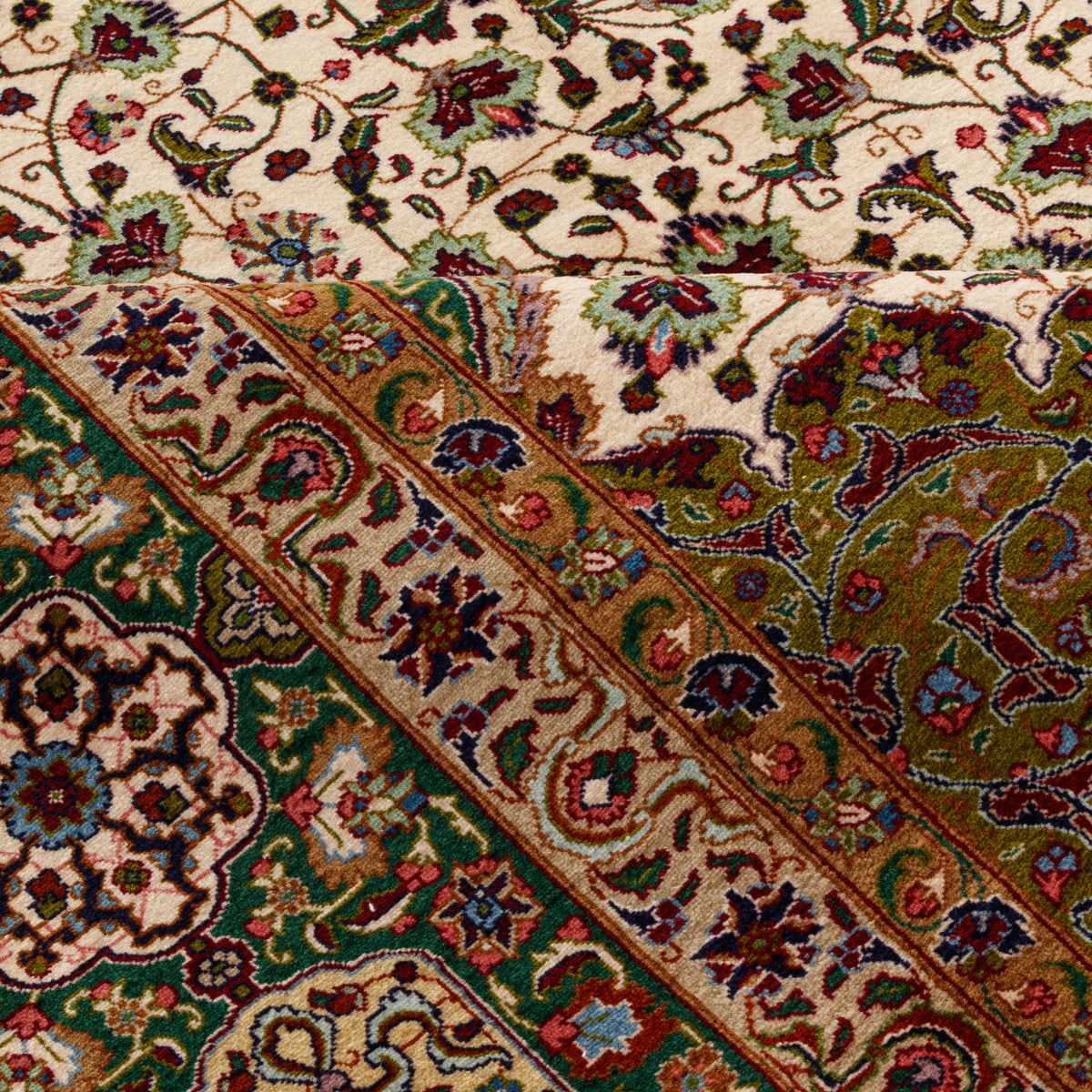
- Lay the back of the carpet flat without stretching it. Stretching changes the spacing and therefore the answer.
- Choose a sound area of knotted pile. Avoid the fringe, the kilim end, the side finish and any repaired area.
- Place a ruler across the width, level with the surface. If you are photographing it, hold the phone as square to the surface as you can.
- Follow a single row and count complete knots. A direct count across a full 7 cm is the most reliable.
- Repeat in two or three other areas of the carpet and report the variation honestly rather than quoting the highest result.
The formula
Raj (7 cm basis) = knots counted × 7 ÷ measured length in cm
| What you counted | Calculation | Result |
|---|---|---|
| 8 knots in 1 cm | 8 × 7 | About 56 raj |
| 30 knots in 3.5 cm | 30 × 7 ÷ 3.5 | About 60 raj |
| 60 knots in 7 cm | Direct count | 60 raj in that sample |
Why short counts are unreliable
This is the part most people miss. If you count over 1 cm and make a one-knot error, the multiplication turns it into a seven-raj error. The same one-knot error counted over a full 7 cm changes the answer by one raj.
The practical consequence: be sceptical of any exact raj figure derived from a blurred photograph or a one-centimetre count. Counting over the longer width costs nothing and is seven times more forgiving.
There is a second trap. Depending on the knot structure, more than one visible coloured segment on the back can belong to a single knot. Counting every visible dot as a separate knot inflates the result. Ask an experienced person to show you one complete knot before you trust your own count. Our guide to how Persian carpets are woven explains the knot structures.
Raj is not knots per square decimetre
Raj is a linear measure. Knots per dm² and knots per square inch are area measures, and converting between them requires counting in both directions — across the width and along the length.
This matters beyond arithmetic. Certificates of authenticity, ours included, record knot density in knots per dm². A raj figure must never be written into that field unconverted; the two numbers describe different things and the resulting document would be wrong. See what a carpet certificate should tell you.
Related terms: kheft and la
Kheft, used around Isfahan
Kheft can refer to a knot, but local trade practice sometimes uses grouped counts or woven markers to describe the weave. Before interpreting a quoted kheft number, establish two things: what unit it uses, and what width it covers. Do not assume every use of "kheft" means exactly one hundred knots.
If the count you are given is expressed in groups of one hundred, first multiply the verified group count by 100 to get the number of knots. Then, if a row contains N complete knots across a knotted width of W centimetres, the average raj on our 7 cm basis is 7 × N ÷ W:
| Measured row | Average raj |
|---|---|
| 2,000 knots across 200 cm | 2,000 × 7 ÷ 200 = 70 |
| 2,000 knots across 250 cm | 2,000 × 7 ÷ 250 = 56 |
The same 2,000 knots produce very different raj figures depending on the width they cross. This is exactly why a knot count without a width is not yet information.
Some Isfahan carpets also carry coloured markers near one end. Before using them, confirm how many knots the intervals represent on that particular carpet, count the intervals rather than the marks, and include an incomplete interval at the end.
La, used for Nain
La describes the number of plies in the warp yarn. Familiar Nain categories are 4-la, 6-la and 9-la. La is not a count of knots, and there is no fixed mathematical conversion from la to raj. Lower-la categories are commonly associated with finer work, but the carpet itself still has to be examined. If you want knot density on a Nain carpet, count the knots.
What a high raj does and does not tell you
More closely spaced knots allow finer detail in the drawing. A design with delicate faces, fine arabesques or small-scale floral work genuinely needs the density to carry it.
But density is one factor among many. The artistic quality of the design and its drawing, colour balance, the yarn, the standard of execution, the condition of the piece and documented authorship all affect what a carpet is worth and whether you will still love it in ten years. A higher density number does not automatically make one carpet the better purchase.
A difficult design can demand extraordinary attention even at a moderate knot count. In our own collection, a 12 m² Gharebaghi-design carpet at 120 raj was reported by our management as taking about six years with two weavers — while a 6 m² Tabriz at 55 to 60 raj took around six months. Density is part of that difference, but so are scale, drawing and the number of hands at the loom.
A note on how we publish these figures
We do not publish raj, kheft or la values on our website or in our product listings. Experienced salespeople develop a visual estimate, and an estimate is described as an estimate. If you would like a measured answer for a specific carpet, ask us and we will count it on that piece rather than quote a category average.
Frequently asked questions
What is raj in a Persian carpet?
Raj is a linear knot count — the number of complete knots across a set width of the carpet. Azimzadeh counts raj across 7 cm of width. Because the basis differs between traders, always ask which width a quoted figure uses.
Is a higher raj always better?
No. A higher raj allows finer detail, but design quality, drawing, colour, yarn, execution, condition and authorship all matter too. A carpet with a moderate raj and an exceptional design can be the better purchase.
How do I count raj myself?
Lay the back flat without stretching it, choose a sound area away from the fringe and edges, place a ruler across the width and count complete knots across 7 cm. Repeat in two or three places. Counting over 7 cm rather than 1 cm reduces the effect of a miscount sevenfold.
Is raj the same as knots per square decimetre?
No. Raj is a linear measure taken across the width. Knots per dm² is an area measure that requires counts in both directions. A raj figure should never be entered into a knots per dm² field without conversion.
Does la tell me the knot density of a Nain carpet?
No. La describes the plies of the warp yarn, not the number of knots. There is no fixed conversion from la to raj; if you want knot density, the knots must be counted.
Why do two sellers quote different raj for similar carpets?
Usually because they are counting across different widths, counting over too short a distance, or counting coloured segments rather than complete knots. Ask for the basis and the method.
Want a carpet counted properly?
If you are comparing two carpets and the numbers do not agree, bring the question to us. We will count the piece in front of you and explain what the figure means for that particular design — including when it does not matter as much as the seller implied.
- WhatsApp: +971 56 322 0485
- Showroom: +971 4 250 2123 — Al Barsha 2, Dubai
- Email: info@azimzadeh.ae
Browse the collections this article refers to: handmade carpets, full silk, wool & silk.
Azimzadeh — Persian carpets since 1969. Dubai showroom: Azimzadeh Carpet Trading LLC, Al Barsha 2. The counting method and 7 cm basis described here are the standard our own sales team is trained on.
Previously in this series: the parts of a Persian carpet. Next: kork, silk and how to read carpet materials honestly. Also useful: Tabriz, Qom, Isfahan and Nain · shaneh in machine-made carpets.