Why Persian Carpets Cost What They Do: A Buyer's Guide
"Why does this carpet cost three times more than that one?" is the most reasonable question a customer can ask, and it deserves a real answer rather than a gesture at the word "handmade".
The honest answer is that six or seven separate factors combine, and they do not always move in the same direction. A carpet can be extremely fine and still cost less than a coarser one with a rarer design or a documented maker. This article sets out the factors one at a time.
1. Weaving time, which is mostly design
The single largest input is human hours at the loom. How many hours depends on the design, the knot density, the number and speed of weavers, the working hours and the production method.
These examples come from our own management's experience. They illustrate the scale of the labour involved — they are not delivery commitments for a new order:
| Carpet | Reported weaving time |
|---|---|
| Gharebaghi design, 12 m², 120 raj | About 6 years, with 2 weavers |
| Tabriz, 6 m², silk warp, 55–60 raj | About 6 months |
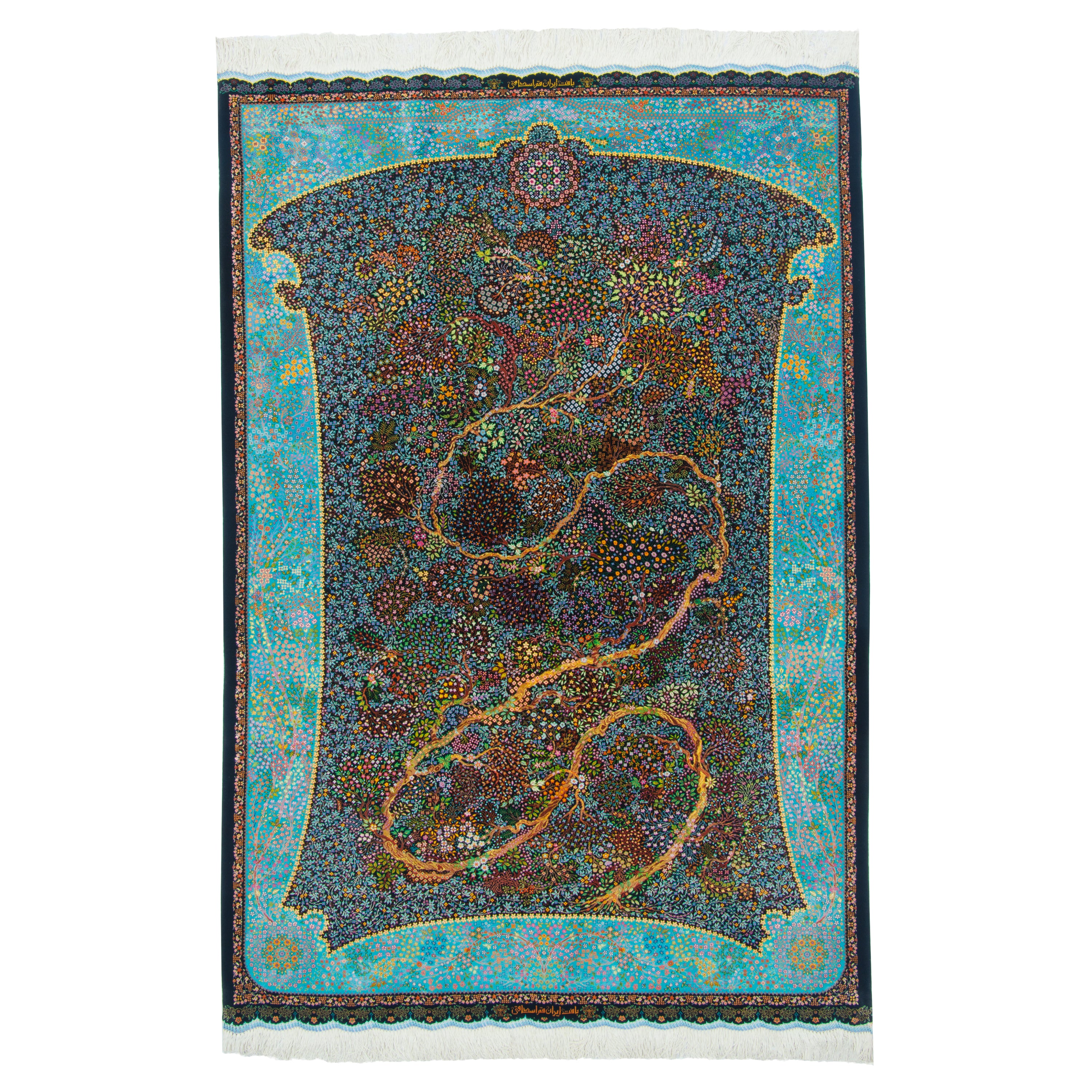
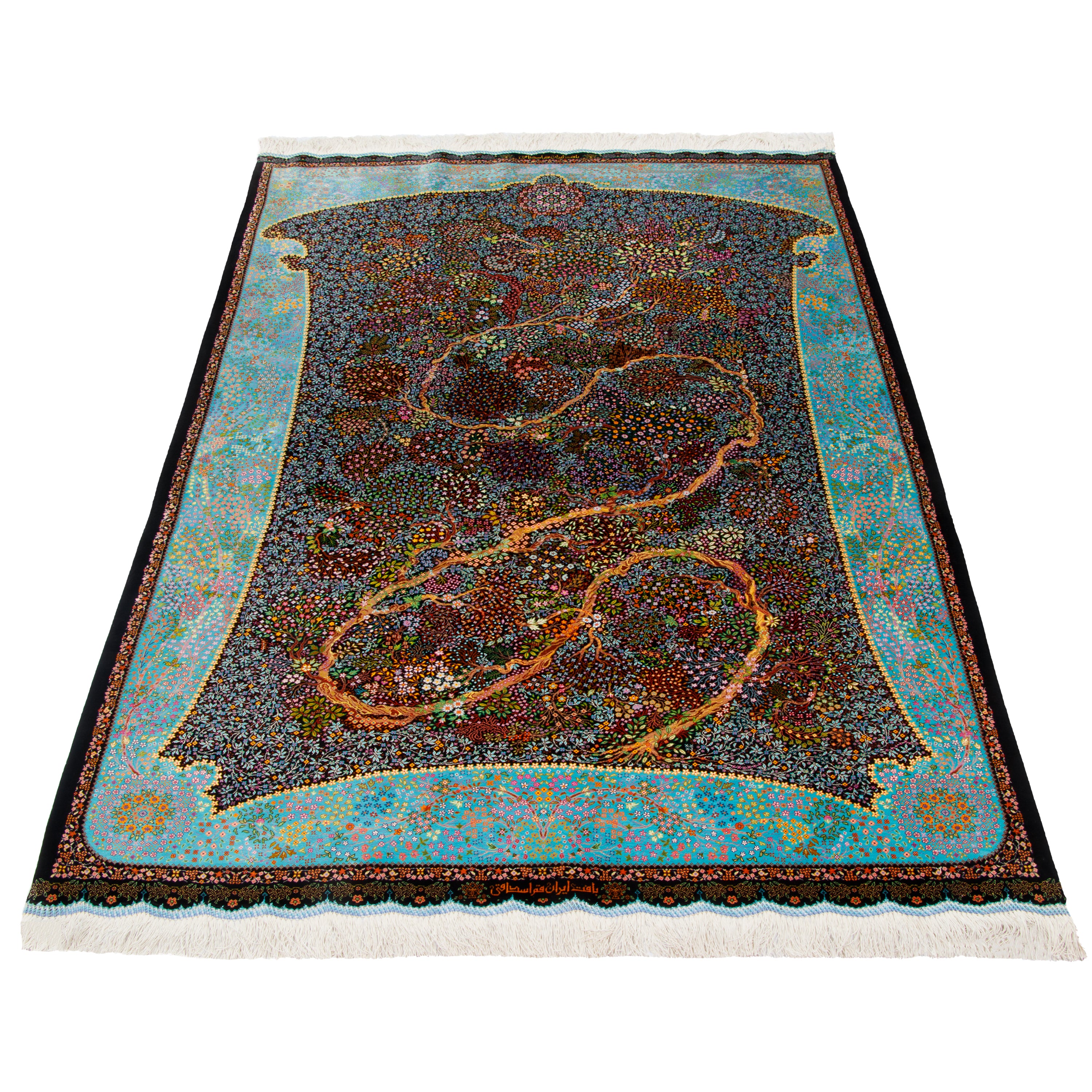
| Qom, 6 m², full silk, 70 raj | About 9–11 months |
| Tabriz portrait, 100 × 150 cm, 50 raj | About 6 months |
Look at the last row. A carpet of 1.5 m² taking roughly six months tells you something important: area and time are not proportional. A portrait design demands constant colour changes and close attention at every row. A simpler field of the same size moves far faster.
The number of weavers was specified only for the first example, so these figures cannot be used to calculate a universal production speed. Our guide to how Persian carpets are woven explains why a complex chart takes so long.
2. The design and the quality of its drawing
Two carpets can share a design name and differ enormously in execution. The drawing — how well the curves resolve, how the medallion relates to the corners, how the border frames the field — is the work of a designer, and it is visible. Our guide to Persian carpet designs explains the main layouts.
A complex chart demands careful colour changes and sustained attention even when the carpet's dimensions are modest. This is why a difficult design at a moderate knot count can be worth more than an easy design at a high one.
3. Materials
Silk costs more than wool, and fine kork wool costs more than ordinary wool. But the material description has to be read carefully — a silk warp is not a silk carpet, and silk highlights are not a full-silk pile. Our guide to reading carpet materials covers the distinctions in detail.
4. Fineness
Higher knot density allows finer detail and takes longer to weave. It is a genuine cost driver — but as we explain in our guide to raj, a higher number does not automatically mean the better carpet for you.
5. Size, and the disproportionate cost of large pieces
Area raises price directly, but very large carpets cost more than their square metres suggest. They need larger looms, longer uninterrupted production, more capital tied up and far more storage space. Only a few workshops take them on.
Our collection has unusual depth in carpets larger than 24 m², including sizes such as 4.5 × 7 m, 1.5 × 13 m, 10 × 15 m and 6 × 12 m. The largest works in the collection are a pair measuring 20 × 30 m each — 600 m² per carpet — from a design by Master Khiabani.
One arithmetic note when you are quoted a pair: two 6 × 12 m carpets are two pieces of 72 m² each. They are not one continuous 144 m² carpet. See our guide to Persian rug sizes for how carpets are named and measured.
6. Condition
Wear, repairs, restored areas and structural soundness all affect value. Rafou — repair or restoration work — may involve the pile, the foundation, the fringe or the edges. Its extent and its suitability depend entirely on the individual carpet.
Repair is not the same as cleaning, and the presence of a repair is not automatically a negative. A well-executed old restoration on a rare piece is very different from recent damage on an ordinary one. Read more in our guide to carpet repair and restoration.
7. Maker attribution and scarcity
A recognised workshop or designer name affects price, but only when the record supports it for that particular piece. A signature woven into a carpet supports identification; it is not by itself proof of authenticity or of personal weaving by the named master.
It helps to separate four roles that are often collapsed into one. A designer creates the drawing. A workshop organises production. A weaver executes the work. A commissioner orders it. One person can hold more than one role, but a name woven into a carpet does not establish all four.
Among the names you will meet in our collection are Kashizadeh, Kafashzadeh, Saeed and Mir Mehdi in Qom; Seirafian and Golparvar in Isfahan; Amu Oghli in Mashhad; and Salari, Gharebaghi, Khatibi and Haji Jalili among Tabriz design and trade names. Our guide to Persian carpet weaving centres covers these in more detail.
We purchase the completed production of the Kashizadeh workshops in Qom exclusively, which makes their carpets a particularly important part of our Qom collection.
Old and collectible carpets
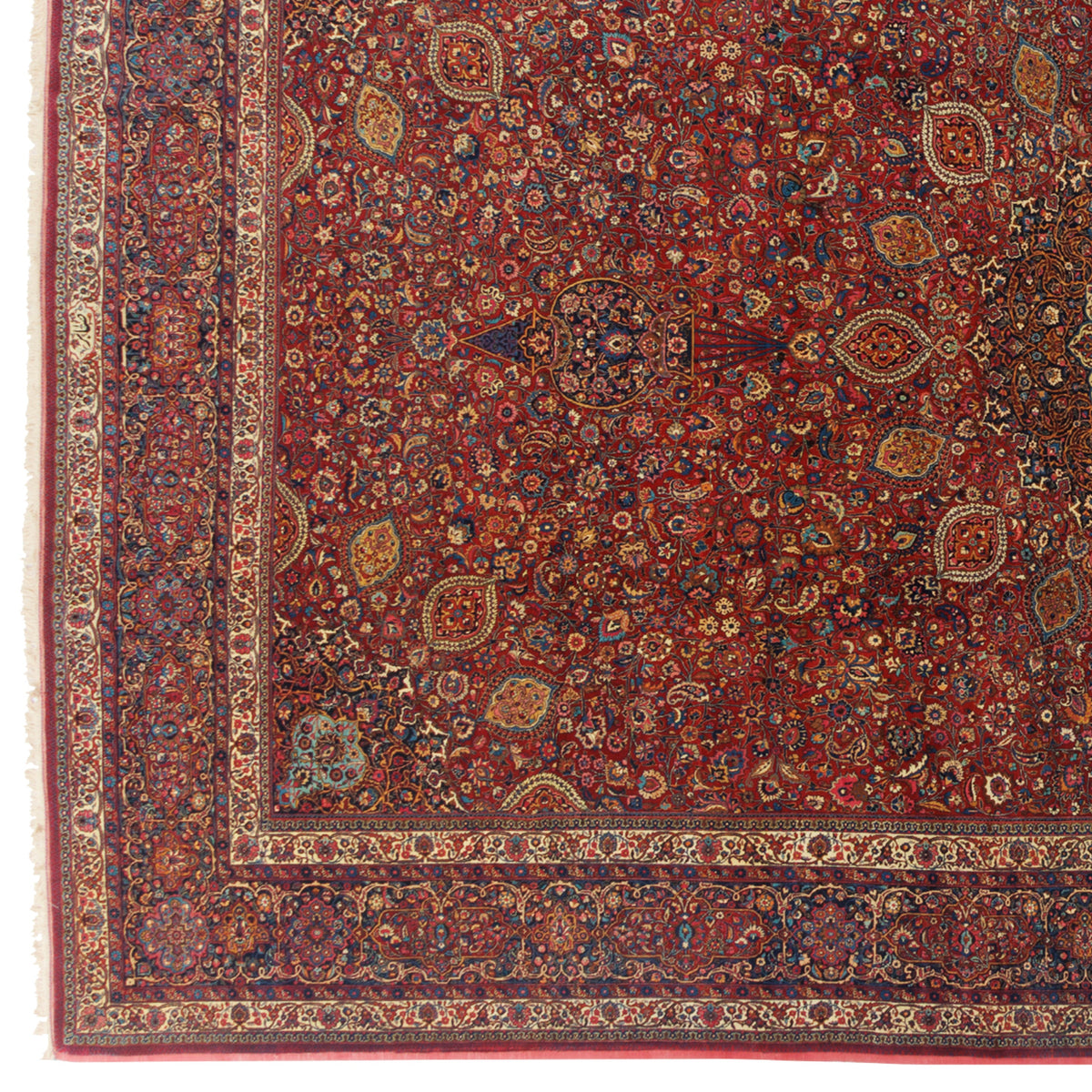
Our older collection and rare antique pieces include carpets described by our management as more than fifty years old.
Two cautions are worth stating plainly. First, the word "antique" is used differently in different markets and is not a substitute for stating an age — ask for a documented age or a properly qualified estimate. Second, a weaver or workshop that no longer produces may have a limited surviving body of work, which genuinely interests collectors, but age alone does not establish a future price.
What no honest seller can promise you
We will not promise that a carpet will appreciate, achieve a particular auction result or deliver an investment return. Nobody can know this, and a seller who tells you otherwise is selling you a feeling rather than a carpet.
A carpet is bought because the design, colour and scale are right for your room and because you want to live with it. If it also holds its value, that is welcome — but it should not be the reason for the purchase.
If you need a formal valuation or a detailed history of a specific piece, that is a separate exercise from a sales conversation, and we will treat it as one.
Frequently asked questions
Why are handmade Persian carpets so expensive?
Mainly because of the human hours involved. A fine carpet can take months or years at the loom. Design complexity, materials, knot density, size, condition and maker attribution then adjust the figure up or down.
How long does it take to weave a Persian carpet?
It depends far more on design and density than on size. Reported examples from our collection range from about six months for a 6 m² Tabriz at 55–60 raj to about six years for a 12 m² carpet at 120 raj with two weavers. A small portrait design can still take six months.
Does a higher knot count mean a more expensive carpet?
Usually it raises the price, but not always decisively. A difficult design at a moderate knot count can be worth more than a simple design at a high one.
Are Persian carpets a good investment?
We do not make investment claims. Age, rarity and a recognised maker genuinely interest collectors, but no seller can promise appreciation or a future auction result. Buy a carpet because it suits your space and you want to own it.
Does a woven signature prove who made the carpet?
No. A signature supports identification but does not by itself prove authenticity or that the named master personally wove the piece. The product record for that carpet is what matters.
Why do very large carpets cost more per square metre?
They require larger looms, longer uninterrupted production, more capital and substantial storage. Fewer workshops are able to produce them, which also limits supply.
Talk to us about a specific carpet
Price makes far more sense in front of an actual carpet than in the abstract. Tell us the room, the size you need and roughly what you want to spend, and we will show you where that budget goes furthest — including when the honest answer is a smaller, finer piece or a larger, simpler one.
- WhatsApp: +971 56 322 0485
- Showroom: +971 4 250 2123 — Al Barsha 2, Dubai
- Email: info@azimzadeh.ae
Start browsing: handmade carpets · classic & traditional · old handmade rugs
Azimzadeh — Persian carpets since 1969. Dubai showroom: Azimzadeh Carpet Trading LLC, Al Barsha 2. Collection figures and weaving-time examples are supplied by our management and describe our own stock. Confirm current availability and the details of any individual carpet before committing to it.
Read the rest of this series: the parts of a Persian carpet · what is raj · reading carpet materials · carpet certificates