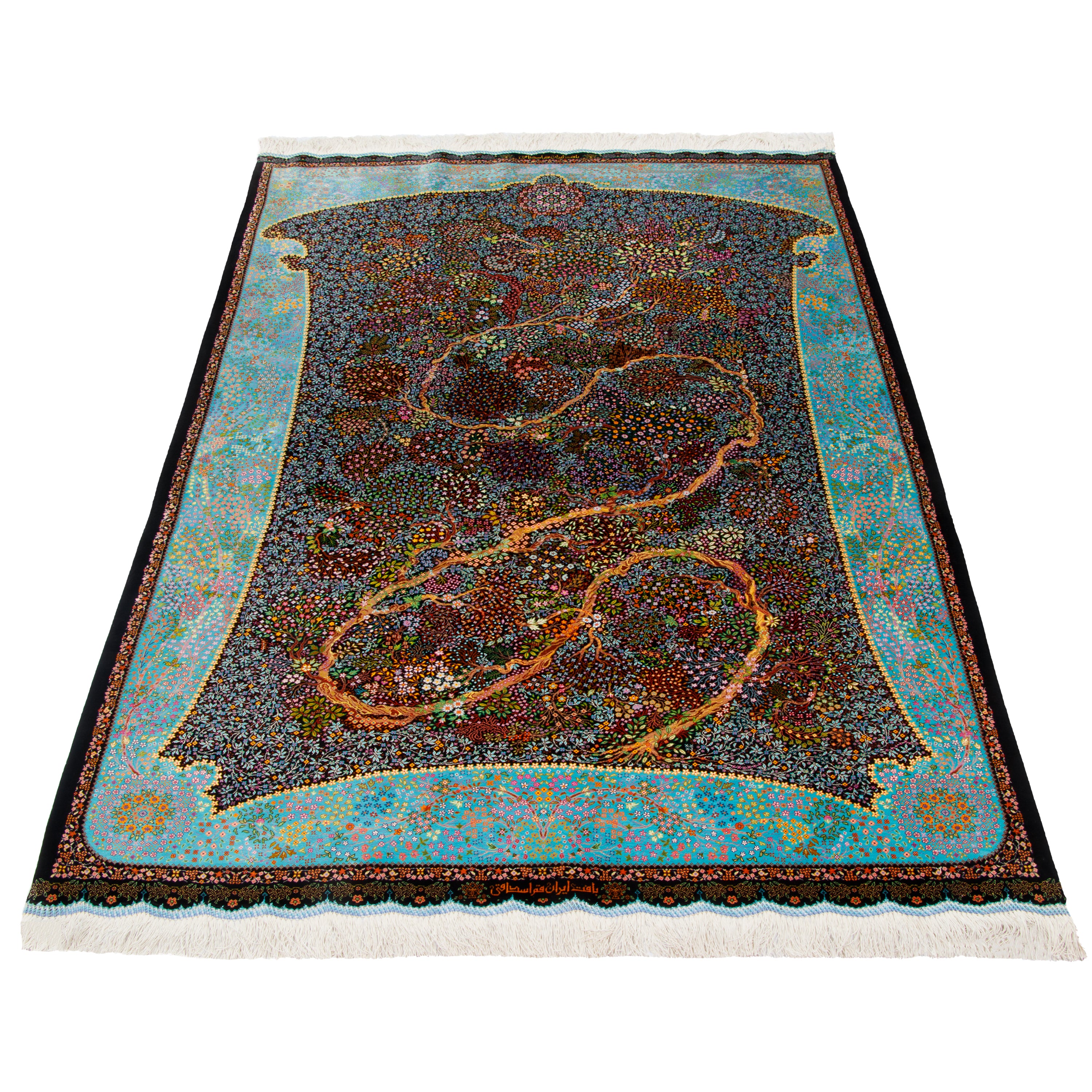

The Ardabil Carpet: History of the Design and Our Tabriz Pair
The Ardabil Carpet is probably the most famous Persian carpet in the world. It hangs in the Victoria and Albert Museum in London, and its design has been copied and reinterpreted for well over a century. What many people do not know is that it was one of a pair, and that its twin survives too.
This article tells the story of the historical carpets, explains a common misconception, and introduces the pair we commissioned in Tabriz using the Ardabil design.
The historical Ardabil carpets
The carpets are dated in their inscription to the year 946 of the Islamic calendar, which corresponds to 1539–40 CE, during the Safavid period. They are associated with the shrine of Shaykh Safi al-Din at Ardabil in north-western Iran, the resting place of the ancestor of the Safavid dynasty. The inscription includes a couplet from the fourteenth-century poet Hafiz and the name of Maqsud Kashani.
| Feature | The London carpet (V&A) |
|---|---|
| Date | AH 946 / 1539–40 CE |
| Approximate size | About 10.5 × 5.3 m |
| Foundation | Silk warp and weft |
| Pile | Wool, in ten colours |
| Knot density | About 5,300 knots per dm² (roughly 340 per square inch), as published by the museum |
The design is built around a central medallion surrounded by smaller ornaments, with related corner pieces, and it includes two lamp motifs of different sizes. The difference in size is often explained as a deliberate optical effect, so that the two lamps appear equal when the carpet is seen from one end. In the terms used in our guide to Persian carpet designs, it is a medallion-and-corner (lachak toranj) composition of exceptional refinement.
Note that the museum's density figure is an area measure. It cannot be read directly as a raj figure, which counts knots along a single line. Our guide to raj explains the difference.
A pair, not a single carpet
It is inaccurate to say that only one Ardabil carpet survives. The Victoria and Albert Museum acquired its carpet in 1893. The second carpet of the pair is in the Los Angeles County Museum of Art (LACMA), which received it as a gift from J. Paul Getty.
The two carpets have an intertwined history. Before the London carpet was acquired, material from the second carpet, including its outer borders, is believed to have been used to repair the first. As a result, the Los Angeles carpet is smaller, at roughly 7.2 × 4 m, and was later given a new outer border.
You can read the museums' own records here: the Ardabil Carpet at the V&A and the Ardabil Carpet at LACMA.
Our contemporary pair, woven in Tabriz
Azimzadeh commissioned a contemporary recreation of the Ardabil design. Like the historical carpets, ours is a pair.

| Feature | The Azimzadeh Ardabil pair |
|---|---|
| Number of carpets | Two |
| Dimensions of each | 6 × 12 m |
| Area of each | 72 m² |
| Weaving centre | Tabriz |
| Knot count | 60 raj (7 cm basis), as reported by our management |
| Structure | Silk warp, kork wool pile and silk highlights |
| Location | Our UAE branch, Dubai |
These are two separate carpets of 72 m² each, not one continuous carpet of 144 m². Each is somewhat larger than the London original, so the design has been adapted to a new scale. You can browse other pieces of this size in our handmade carpets larger than 24 m².
The details, up close
The features that make the Ardabil design famous are all present in our pair: the hanging lamps, the central medallion with its surrounding ovals, and the inscription cartouche, which carries the name of Maqsud Kashani and the date 946 in the same position as on the original design.


View this carpet in our collection
A recreation, not the original
It is worth being clear about what a recreation is. Our pair are new works woven from the historical design. They are not the museum carpets, and they are not presented as such.
The history of the design enriches these carpets; it is part of why they are remarkable to stand beside. But history does not guarantee that a contemporary recreation will acquire the same historical importance or financial value as a museum original, and we do not suggest that it will. They are extraordinary carpets in their own right, for a space large enough to hold them.
Frequently asked questions
Where is the Ardabil Carpet?
The best-known Ardabil Carpet is in the Victoria and Albert Museum in London. The second carpet of the pair is in the Los Angeles County Museum of Art.
How old is the Ardabil Carpet?
Its inscription dates it to AH 946, which corresponds to 1539–40 CE, in the Safavid period.
Is there only one Ardabil Carpet?
No. The Ardabil Carpet was one of a pair, and both survive. Material from the second carpet is believed to have been used to repair the first before the London carpet was acquired in 1893.
What is the Ardabil Carpet made of?
According to the V&A, the London carpet has a silk warp and weft and a wool pile in ten colours.
Is the Azimzadeh Ardabil pair an original?
No. It is a contemporary pair commissioned by Azimzadeh and woven in Tabriz using the Ardabil design. Each carpet measures 6 × 12 m, with a silk warp, a kork wool pile and silk highlights.
See the pair in Dubai
Photographs cannot convey a carpet of 72 m². If you are furnishing a space on this scale, contact us to arrange a viewing and check current availability.
- WhatsApp: +971 56 322 0485
- Showroom: +971 4 250 2123 — Al Barsha 2, Dubai
- Email: info@azimzadeh.ae
Azimzadeh — Persian carpets since 1969. Dubai showroom: Azimzadeh Carpet Trading LLC, Al Barsha 2. Historical details are drawn from the published records of the Victoria and Albert Museum and the Los Angeles County Museum of Art. Specifications of our contemporary pair are supplied by our management; confirm availability before making plans.
Related reading: Persian rug sizes and very large carpets · Tabriz and the other weaving centres · commissioning a carpet